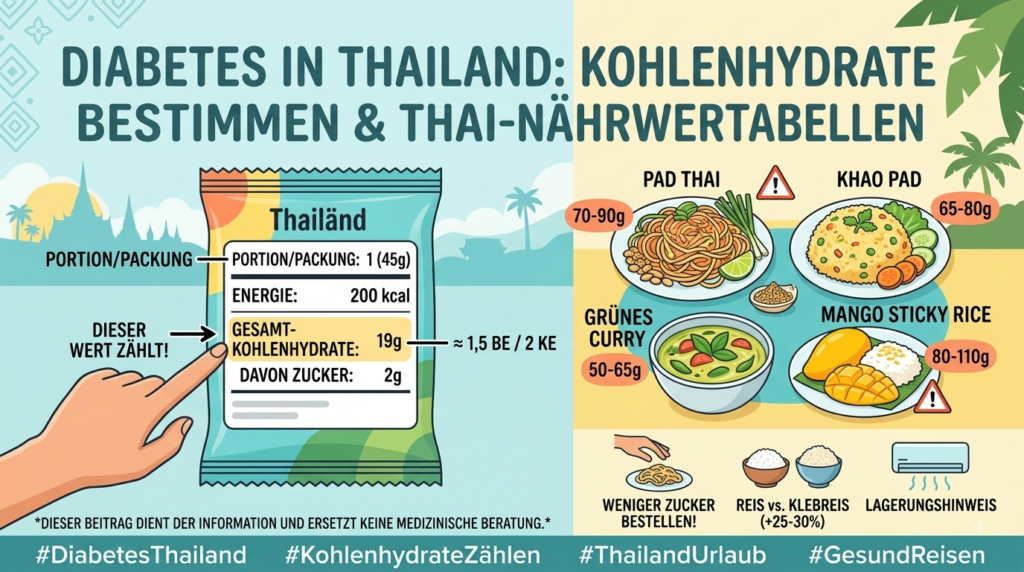
Diabetes in Thailand: Counting Carbs. Diabetes and Its Consequences! Sugar Doesn’t Hurt… Know How Many Carbs You’re Eating!
I’d also like to note here that every diabetes treatment has its pros and cons. This post focuses on insulin therapy and counting carbohydrates. Those who use weight-loss injections or take oral medication might be smiling a little right now. But your treatment is determined by your doctor, and together with your doctor, you can adjust your treatment and weigh the pros and cons.
Anyone traveling in Thailand who needs to calculate their insulin dose due to diabetes often faces a puzzle when reading Thai nutrition labels. In this guide, we show you step-by-step how to read Thai labels correctly, calculate carbohydrates accurately, and what to watch out for when eating on the go.+
Video: Diabetes Thailand Determining Carbohydrates, Thai Nutrition Labels
Language: 🇩🇪|🇬🇧
☝️ Use YouTube subtitles for all languages.
1. The Croissant Example: What Do the Labels on the Packaging Mean?
On packaged foods (like a croissant from 7-Eleven), you will find the nutrition table (ข้อมูลโภชนาการ) at the bottom. Often, the “Sugar” line causes confusion when you want to calculate your carbohydrates (carbs).
The Crucial Principle for Insulin Calculation:
The sugar content does not need to be converted or added to the total carbohydrates! The listed sugar is already fully included in the total carbohydrate value.
- คาร์โบไฮเดรตทั้งหมด (Total Carbohydrates): 19 g <– This value counts for your dose!
- น้ำตาลทั้งหมด (Total Sugars): 2 g (already included in the 19 g total carbs)
Practical Conversion (Example: 1 Croissant / 45 g)
- Calculation using CU (Carbohydrate Unit = 10 g Carbs):
- 19 g Carbs ÷ 10 = 1.9 CU (approx. 2 CU)
- Calculation using BU (Bread Unit = 12 g Carbs):
- 19 g Carbs ÷ 12 = 1.58 BU (approx. 1.5 BU)
2. Standard Labeling in Thailand (FDA Standard)
Nutritional information in Thailand follows strict guidelines set by the Thai Food and Drug Administration (FDA) and is largely standardized:
- Consistent Layout: The line Total Carbohydrates (คาร์โบไฮเดรตทั้งหมด) is always listed as the main header. Sugar (น้ำตาลทั้งหมด) is indented below it as a sub-item.
- Pay Attention to Serving Size (หน่วยบริโภค): Nutritional values do not always apply to the whole package. If the top states e.g. Servings per container: 2, all values in the table must be doubled if you consume the entire package.
- Dietary Fiber (ใยอาหาร): Similar to the US system, fiber is included in the total carbohydrates and is listed indented below them where applicable.
3. Diabetes Practical Tips for Everyday Life & Street Food in Thailand
Fresh food from street stalls or restaurants lacks nutrition labels. Furthermore, Thai cuisine hides a few typical traps regarding hidden sugars.
The Most Important Everyday Rules
- Hidden Sugar in Sauces: Thai dishes (even savory curries or stir-fries) are frequently prepared with generous amounts of palm or cane sugar. It is safer to calculate a bit more insulin for sauces.
- Ordering at Street Stalls & Drink Stands: Say “no sugar, please” to the cook when ordering. This saves you carbohydrates and works for drinks as well, e.g., “Thai Iced Tea”. You will often be offered a sugar substitute instead. You can use the terms Mai waan (ไม่หวาน) for “not sweet / no sugar” or Waan noi (หวานน้อย) for “a little sweet”.
- Watch Out for Sticky Rice: Sticky rice (Khao Niao) is packed more densely than regular jasmine rice and contains about 25–30% more carbohydrates for the same visual portion size.
Estimated Values for Classic Thai Dishes
| Dish | Typical Composition | Est. Carbohydrates (g) | Approx. BU / CU | Note for People with Diabetes |
| Pad Thai(ผัดไทย) | Rice noodles, tofu/shrimp, egg, peanuts, sauce | 70 – 90 g | 6 – 7.5 BU / 7 – 9 CU | Caution: Sauce contains a lot of palm sugar. Rapid spike in blood sugar! |
| Khao Pad(ข้าวผัด) (Fried Rice) | Jasmine rice, vegetables, egg, meat/shrimp | 65 – 80 g | 5.5 – 6.5 BU / 6.5 – 8 CU | Cooking fat slightly slows down carbohydrate absorption. |
| Green / Red Curry | Coconut milk curry + 1 bowl of rice | 50 – 65 g | 4 – 5.5 BU / 5 – 6.5 CU | Main carbs come from the rice (approx. 45–50 g/bowl). Fat slows down the spike. |
| Som Tum(ส้มตำ) (Papaya Salad) | Green papaya, tomatoes, peanuts, dressing | 15 – 25 g | 1 – 2 BU / 1.5 – 2.5 CU | Low carbs in papaya, but watch out for sugar in the dressing. |
| Pad Krapow with Rice | Minced meat/chicken, basil, rice (+ egg) | 50 – 65 g | 4 – 5.5 BU / 5 – 6.5 CU | Moderate sauce sugar; main source of carbs is the rice. |
| Mango Sticky Rice | Sticky rice, coconut sauce, fresh mango | 80 – 110 g | 6.5 – 9 BU / 8 – 11 CU | Very high carb density: Usually leads to a steep blood sugar spike. |
This article does not constitute medical advice. It merely presents information regarding diabetes in Thailand. Always consult a specialist; in Thailand, this is generally done at a hospital.
I always recommend:
- Pattaya City Hospital, where you can get by easily with English. Price-performance ratio is top in my rating.
- Memorial Hospital, where you can get by easily with English. Higher price point – very good services.
- Bangkok Hospital, interpreter service available upon request. Performance and professionalism are top notch with everything you might expect, health insurance recommended.

Support / Donation Link for the Channel
If my posts have been helpful or supported you in any way, I’d truly appreciate your support 🙏
#DiabetesThailand #CarbCounting #NutritionLabel #DiabetesTravel #ThailandTravel